Soil Properties
This section documents the parameters and assumptions behind the soil property inputs that govern the simulation of geochemical interactions. These properties play a key role in determining the dissolution kinetics of basaltic minerals, cation release, secondary mineral formation, and the subsequent sequestration of CO₂ via carbonate precipitation and bicarbonate transport. The following definitions provide clarity on how each parameter is assumed and modeled.
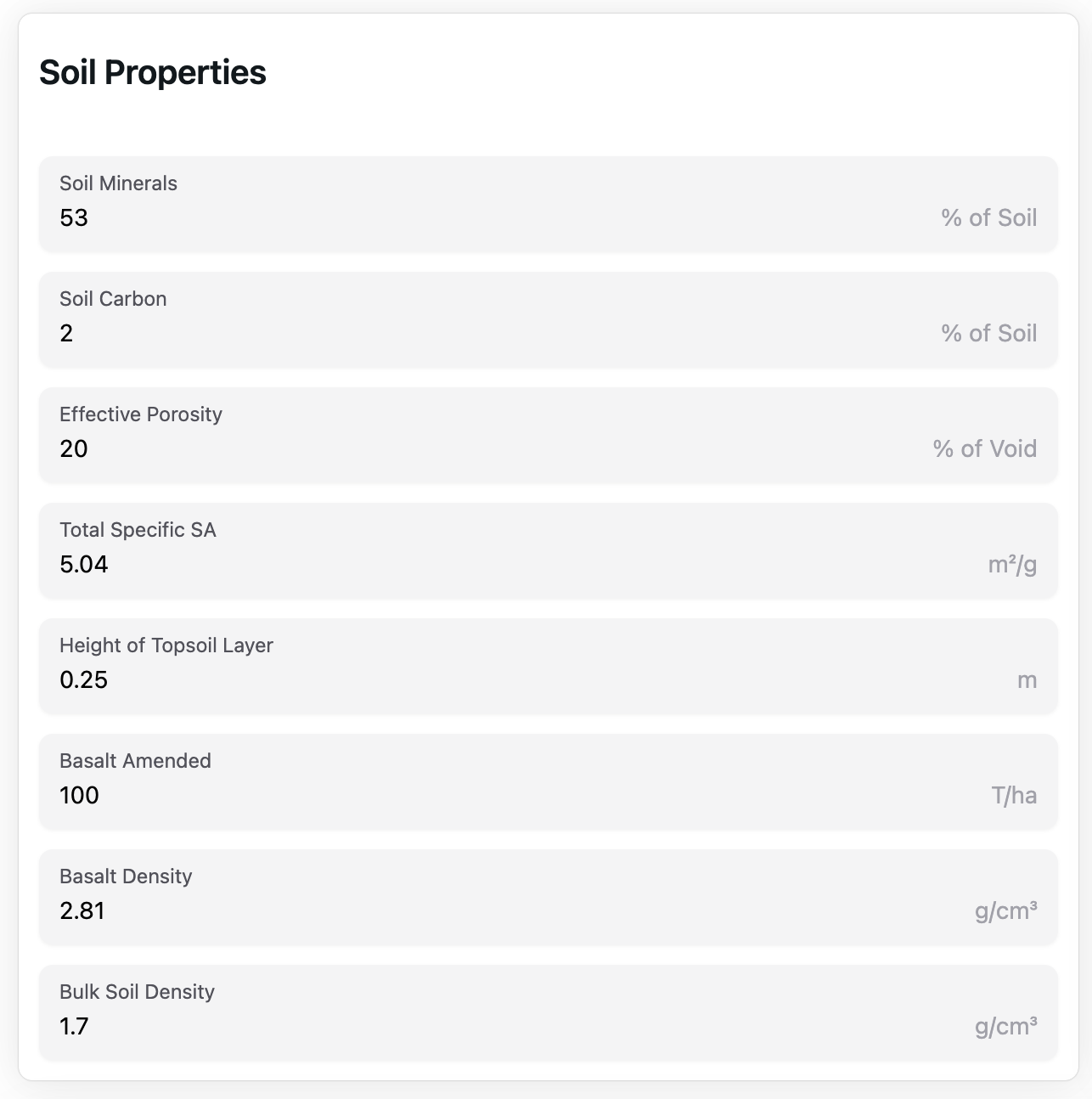
Explanation of Soil Properties Panel
The Soil Properties Panel collects and specifies both physical and chemical characteristics of the soil system. The parameters are used to define the simulation environment in which enhanced weathering processes occur. In particular, the panel addresses:
- Soil Mineralogy: Reflects the composition and proportion of primary and secondary minerals. In our tool, basaltic mineral phases are emphasized given their high reactivity and capacity to release key cations necessary for CO₂ sequestration.
- Porosity: Represents the fraction of the soil volume that is void space. This metric is critical for estimating water retention and transport, which affect reaction kinetics and the diffusion of solutes.
- Soil Amendments: Defines the rate and extent of material (e.g., crushed basalt) addition to the soil. Amendment rates are assumed based on optimized application scenarios for maximizing weathering rates without significantly altering soil structure.
- Hydrological Parameters: Include water content, hydraulic conductivity, and flow rates. These values are set to simulate realistic infiltration and percolation, thereby governing the transport of dissolved species and the pH evolution during the reaction.
- Soil pH and Buffer Capacity: The initial pH is assumed from typical soil conditions, while the buffering capacity is linked to the mineral composition and organic matter content. These factors determine how quickly the soil system responds to acid–base changes during mineral dissolution and carbonate formation.
- Cation Exchange Capacity (CEC): Although not always explicitly adjustable, the CEC is considered to impact the retention and mobility of cations (e.g., Ca²⁺, Mg²⁺) released during basalt weathering, influencing secondary mineral precipitation.
- Temperature: Although set as an environmental constant in many simulations, temperature impacts both reaction kinetics and solubility equilibria. It is typically assumed to be ambient unless otherwise specified.
Definitions of Key Soil Metrics
Below is a detailed definition of each key metric used within the simulation:
-
Mineralogical Composition:
Definition: The quantitative distribution of primary (e.g., olivine, pyroxene) and secondary minerals within the soil.
Assumption: Basaltic minerals are the primary phase, with minor constituents modeled to simulate realistic soil heterogeneity. Their reactivity is tuned to replicate natural weathering processes. -
Porosity (%):
Definition: The ratio of the volume of voids to the total soil volume.
Assumption: A typical range for agricultural or weathered volcanic soils (e.g., 30–50%) is assumed to allow sufficient water percolation and gas exchange without overestimating the effective reactive surface area. -
Amendment Rate (kg/m³ or ton/ha):
Definition: The mass of added basalt (or analogous material) per unit volume or area of soil.
Assumption: Rates are derived from field trials and literature (e.g., Beerling et al. 2020), balancing between maximizing reaction surface area and avoiding adverse soil structure changes. -
Hydraulic Conductivity (m/s):
Definition: A measure of the soil’s ability to transmit water under a hydraulic gradient.
Assumption: Values are chosen based on typical coarse-textured soils where water movement supports efficient transport of dissolved ions and facilitates reaction kinetics. -
Water Content (% by volume):
Definition: The proportion of water held within the pore spaces of the soil.
Assumption: Set to represent conditions that favor both sufficient contact between water and minerals and realistic evaporation/infiltration dynamics. -
Initial pH:
Definition: The starting acidity/alkalinity level of the soil environment.
Assumption: Typically near-neutral to slightly acidic conditions are assumed (pH 6–7), reflective of many temperate soils, with buffering effects accounted for by the inherent mineralogy and organic content. -
Cation Exchange Capacity (meq/100 g):
Definition: The soil’s capacity to retain and exchange cations, which influences nutrient availability and secondary mineral formation.
Assumption: Based on average soil values, this parameter is set to influence the mobility of weathering-released cations, with higher CEC values suggesting more efficient retention and slower migration through the soil matrix. -
Temperature (°C):
Definition: The ambient temperature at which the geochemical reactions are simulated.
Assumption: While typically fixed at ambient conditions (e.g., 15–25°C), variations in temperature are acknowledged as a factor that can modulate reaction rates and equilibria.
These definitions are integrated into the simulation model to provide researchers with a transparent and reproducible framework for assessing the potential of enhanced weathering as a carbon dioxide removal (CDR) strategy and for evaluating soil fertility outcomes.